
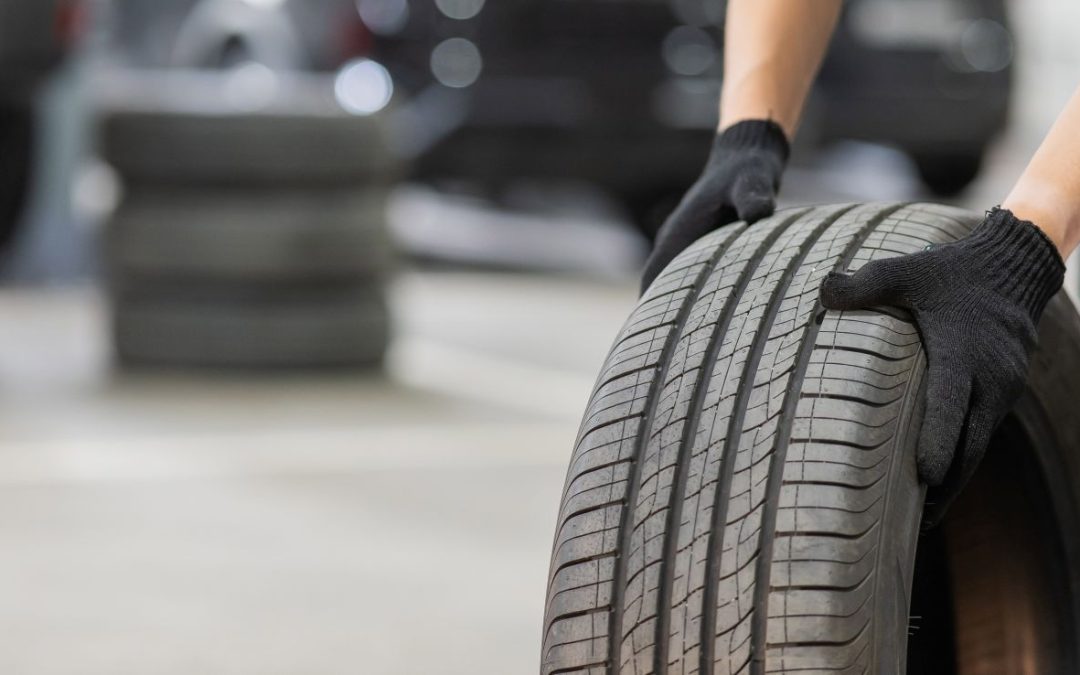
Kingston Pike is one of the busiest commercial corridors in East Tennessee, and the stop-and-go pattern from Bearden out to West Town Mall is exactly the kind of driving that accelerates front tire wear. The front tires on most Nissans handle both steering and braking, so they’re already working harder than the rear. Add in the heat of a Knoxville summer, and tires that look adequate in May can tell a different story by August.
The tire service team at Ted Russell Nissan handles inspections, rotations, balancing, and replacements for all Nissan models. Schedule online or give us a call.
What does a Nissan tire wear pattern actually tell you?
Tires don’t just wear out. They wear in patterns, and those patterns are the most useful information available about what’s going wrong before a tire fails. Reading the wear correctly saves money and prevents replacing a tire only to have the same thing happen to the new one.
How do you check a Nissan’s tire tread depth at home?
The legal minimum tread depth is 2/32 of an inch, but on wet roads, and Knoxville sees plenty of summer rain, tires at the legal minimum have significantly longer stopping distances than tires with 4/32 or more of tread remaining. The practical threshold for replacement in a market with regular wet conditions is 4/32, not 2/32.
A quick way to check at home: insert a quarter into the tread groove with Washington’s head pointing down. If the top of his head is visible, the tire is at or below 4/32 and due for replacement. The penny test identifies the legal 2/32 minimum but by that point wet-road performance is already significantly degraded.
Check multiple grooves across the width of the tire, not just one spot. Wear is often uneven across the tread width, and a single measurement in the center can miss significant edge wear that the full-width check would catch.
How does Knoxville driving affect Nissan tire pressure?
Tire pressure isn’t static. It rises with temperature, approximately one PSI for every 10-degree Fahrenheit increase. In a Knoxville summer, where ambient temperatures regularly reach the upper 80s and 90s and pavement surface temperatures run significantly higher, a tire set to the correct spec in the morning can be meaningfully overinflated by early afternoon. Overinflated tires wear faster in the center of the tread and reduce the size of the contact patch, which affects braking and wet-road handling.
The correct inflation spec for any Nissan is on the sticker inside the driver’s door jamb, not on the sidewall. The sidewall number is the tire’s maximum pressure, not the vehicle’s recommended operating pressure. Checking monthly, and always on cold tires, keeps the reading accurate. A tire that’s been driven even a short distance on a hot day will give an artificially high reading.
Why does a Nissan need regular tire rotation in Knoxville?
Front tires on most Nissans wear faster than rear tires because they carry more of the braking load and all of the steering load. In a city where much of the daily driving involves repeated stops and acceleration across the commercial stretch of Kingston Pike, that front-end workload adds up faster than it would on more open road driving.
Rotation moves each tire to a different position so the wear distributes evenly across all four. Skipping rotation doesn’t just shorten the life of the front tires. It means the set goes uneven, and uneven tread across four tires means the vehicle responds differently at each corner, which matters most when braking quickly on a wet road.
Nissan generally recommends rotation every 5,000 to 7,500 miles. Pairing it with an oil change at the same visit keeps the schedule simple and ensures it actually happens on time.
What happens during a tire service visit at Ted Russell Nissan?
After a rotation or new tire installation, the TPMS sensors need to relearn their new wheel positions, since the system tracks which sensor corresponds to which corner of the car. Nissan’s relearn procedure uses a dedicated tool to trigger this, rather than relying on the system to sort itself out after a few miles of driving. Skipping this step is a common reason a TPMS light stays on even after tires that were actually fine got serviced.
New tire installation includes a final torque check on the lug nuts after the first several miles, since a wheel can settle slightly once it’s back under load. The technician also checks that the spare, if the vehicle has one, is properly inflated and in usable condition. It’s an easy thing to overlook, but a flat spare defeats the purpose of having one.
When should you bring your Nissan in for tire service in Knoxville?
Anytime the tread is approaching 4/32 across any part of the tire, or when the wear looks different from one part of the tire to another, is the right time for a visit. The patterns are easiest to catch early and cheapest to address before they result in a premature replacement.
Vibration at highway speed on I-40 or I-75, pulling to one side, a TPMS light that comes on and won’t clear after inflating, or any visible sidewall damage are all signs that shouldn’t wait. The same goes for tires that are visibly aged: cracking or dry-rotting sidewalls on a tire that otherwise looks fine on tread depth is a replacement situation regardless of the tread reading.
The tire service team at Ted Russell Nissan serves Knoxville and the surrounding Knox County area, including Farragut, Alcoa, Maryville, and Powell. Schedule online or call the service department directly.